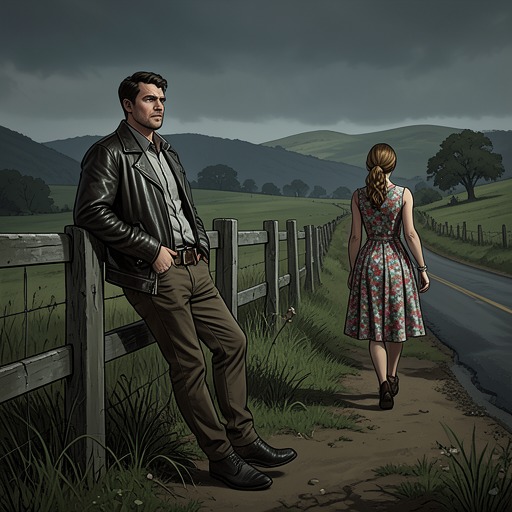
Mike leaves Donna after Rachel’s marriage
Cry MachoMike leaves Donna after Rachel’s marriage in a decisive rupture that begins his “lost year.” The separation is quiet rather than angry: Donna helps him pack, and their tender parting exposes an intimacy that had not disappeared even as their marriage had become unworkable. That evening, Mike’s grief over Laurie breaks through in a drunken outburst at her grave, giving the departure a deeper weight than a failed romance alone.
The Marriage and the Decision to Leave
Mike has been worrying and delaying over whether he can change his mind before marrying Donna. Rachel’s letter, received at the stadium, says she has gone to Shreveport to think things over with her sister and brother-in-law. A month later, Rachel marries her high-school sweetheart. By the morning Mike hears the news, it is too late for his own action to affect her choice; he leaves Donna instead.
The separation is practical as well as emotional. Donna is not angry, and Mike is not angry with her. She helps him pack, reminds him that two sport jackets are still at the cleaners, and insists he take books she knows he cherishes. As he ties a rope around a damaged suitcase, she reserves a room at the hotel where he will stay temporarily. These careful acts make the departure less a quarrel than a painful acknowledgment of the life they have shared.
The Parting and the Lost Year
At the moment he drives away, Donna kisses Mike gently, not as a husband but as a son leaving for the army. The gesture recasts their relationship at the threshold of separation: the tenderness remains, but the intimacy of marriage has altered. The narration stresses that they have not ached for each other this way in a long time, making the parting itself a return of feeling rather than a simple confirmation that it has ended.
Toward evening, drunk and caught in the rain, Mike stands on Laurie’s grave and pounds the wet earth with his feet. He yells that the child is at fault. The outburst follows his departure from Donna on the same day, but its target is his dead daughter, revealing a grief that has not been contained by time or by his adult relationships. The rain and the grave turn the day’s separation into the beginning of a much longer emotional collapse.
Retrospective Frame and Significance
The episode is recalled through a later rainy afternoon whose fine mist resembles the rain on the day Mike left Donna. That sensory resemblance folds the past into the present: the remembered evening becomes the beginning of the “lost year,” while the present-day ache raises the possibility that another such year may follow. The return to the grave and to Mike’s accusation shows how the loss continues to structure his experience, even when the immediate subject is his separation from Donna.
The event joins two forms of loss without treating them as interchangeable. Rachel’s marriage closes off the possibility that Mike’s delayed choice might matter to her; leaving Donna ends a shared life marked by care; and Laurie’s grave exposes a wound that neither decision can settle. Mike’s departure is therefore both an ending and a threshold: the quietness of the packing contrasts with the violence of his later grief, and the day becomes the point from which his “lost year” is measured.